


I have a significant number of leads, from various suppliers where the coatings have cracked and started coming away. I have no idea how or why this has happened (any suggestions would be welcome so I avoid in the future, I store them in a large padded lead pouch that tends to live on the car) but ultimately I am left with a large number of leads of various weights, all fine with swivels etc still attached that I need coated in order to use. I rushed out to West Country leads and whilst he would do it he suggested that it's not economical due to postage costs, if I lived locally it would be fine. Is this something I can do or can someone recommend someone closer to me in South Wales that could sort this out?

In reply to Post #1
I found recoating quite easy.
In essence.
You slightly heat the lead up
Drop in to the powder so it sticks then heat it up again to set the coating then Dunk in water
I found recoating quite easy.
In essence.
You slightly heat the lead up
Drop in to the powder so it sticks then heat it up again to set the coating then Dunk in water
In reply to Post #2
Thanks. Again, I am a complete novice and have no clue on how to make, or coat leads so apologies for the basic questions, but what kind of powder do you use and best places to get it from? If it's as easy as you make out I will definitely have a go on a few to see if I can save a few quid
Thanks. Again, I am a complete novice and have no clue on how to make, or coat leads so apologies for the basic questions, but what kind of powder do you use and best places to get it from? If it's as easy as you make out I will definitely have a go on a few to see if I can save a few quid

In reply to Post #3
HLS sell the powder coating
HLS sell the powder coating
In reply to Post #4
Thank you. Just had a look and it's not expensive and they have a clear guide on their website so may well give it a go. Far cheaper than sending them off somewhere
Thank you. Just had a look and it's not expensive and they have a clear guide on their website so may well give it a go. Far cheaper than sending them off somewhere
Its not a big problem to do it yourself.
I use a normal heatgun or a weed burner for the garden.
Be careful with a open flame, lead melts very fast.
You should have some pliers or thick wire at hand to hold the lead.
Bucket of water to cool the coating.
With inline leads i put some drill bits with the same size of the holes in it. If you get coating in there your inlets dont fit anymore
I use a normal heatgun or a weed burner for the garden.
Be careful with a open flame, lead melts very fast.
You should have some pliers or thick wire at hand to hold the lead.
Bucket of water to cool the coating.
With inline leads i put some drill bits with the same size of the holes in it. If you get coating in there your inlets dont fit anymore

In reply to Post #1
I used to make my own. If you have a gas hob WITH extractor fan it'll do perfectly well as well as protecting you from the fumes. It's a simple job as others have said, remove the old coating then just heat the lead up until it starts to melt the powder, just sprinkle a smidge on, trial and error. You don't want to get it too hot, just enough to melt so the plastic isn't trying to run, keep turning the lead. I used to grip the loop with pliers for this. If you want a rough coat just do the above and as the lead starts to cool add some extra powder so it sticks to the plastic but doesn't melt. You can play with colour combos that way too.
I've got a bucket load of leads and after making and not using them in 15 years the plastics cracked again. Another job for another day.
I can't reiterate enough not breathing the fumes in. If you end up doing it outside just make sure you're well ventilated or wear a mask.
I used to make my own. If you have a gas hob WITH extractor fan it'll do perfectly well as well as protecting you from the fumes. It's a simple job as others have said, remove the old coating then just heat the lead up until it starts to melt the powder, just sprinkle a smidge on, trial and error. You don't want to get it too hot, just enough to melt so the plastic isn't trying to run, keep turning the lead. I used to grip the loop with pliers for this. If you want a rough coat just do the above and as the lead starts to cool add some extra powder so it sticks to the plastic but doesn't melt. You can play with colour combos that way too.
I've got a bucket load of leads and after making and not using them in 15 years the plastics cracked again. Another job for another day.
I can't reiterate enough not breathing the fumes in. If you end up doing it outside just make sure you're well ventilated or wear a mask.

In reply to Post #1
you should be able to fix them by just heating them up lightly to melt the coating as opposed to completely recoating them.
nothing wrong with uncoated leads too - if you are really worried about them appearing shiny, place them in something acidic (vinegar, coca cola etc) for a few days & they will dull down perfectly.
you should be able to fix them by just heating them up lightly to melt the coating as opposed to completely recoating them.
nothing wrong with uncoated leads too - if you are really worried about them appearing shiny, place them in something acidic (vinegar, coca cola etc) for a few days & they will dull down perfectly.
In reply to Post #8
Cheers. I've ordered some of the coating powder as suggested below, only cost a few quid so if it works then it's an inexpensive solution. I think your right, it's as much a confidence thing for me as anything
Cheers. I've ordered some of the coating powder as suggested below, only cost a few quid so if it works then it's an inexpensive solution. I think your right, it's as much a confidence thing for me as anything
I would not worry about coating or recoating a lead, just strip off what is remaining, stick the leads in a box with some fine sand and give them a good shaking from side to side etc for a minute or two. This will just roughen up the lead slightly to get any shine off them and then leave them outside for the air to get to them and they will oxidise and tarnish very fast.in probably a day or two. Leaving them in vinegar, tea, water, gutters, silt, does not work, I have tried them all and if it does, it can take months or even years, I have made leads since the 60's, and the only quick way to tarnish a lead is sand in a box, tub etc, discovering this method was equivalent to discovering sliced bread. Basically, it's just doing what happens to uncoated leads just left in a tackle box etc, with all the movement about when your transporting your kit, they soon go a dull tarnished colour.
I do this with all my leads that I make. For a very long time, divers have always said, the hardest leads to see are uncoated leads as they blend into the bottom. Coated ones stand out on the bottom and can even be reflective due to the lead coating being smooth and shiny and divers report they stand out like a beacon on the bottom.
Basically, coating leads is just an unnecessary fad. We used to catch using uncoated leads for long enough before coated ones came into the system.
I do this with all my leads that I make. For a very long time, divers have always said, the hardest leads to see are uncoated leads as they blend into the bottom. Coated ones stand out on the bottom and can even be reflective due to the lead coating being smooth and shiny and divers report they stand out like a beacon on the bottom.
Basically, coating leads is just an unnecessary fad. We used to catch using uncoated leads for long enough before coated ones came into the system.
In reply to Post #10
Agreed.
Agreed.

In reply to Post #10
Agreed.
Agreed.

In reply to Post #10
I have always made my own leads since I started carping and have never coated one, nor ever used a coated lead. Strangely, the fish don't seem to mind
I do use a bit of vinegar solution to kick start the surface oxidisation, and after a few days I then leave them in the rain to further dull down.
Once they go in the water they become darker grey...


I have always made my own leads since I started carping and have never coated one, nor ever used a coated lead. Strangely, the fish don't seem to mind
I do use a bit of vinegar solution to kick start the surface oxidisation, and after a few days I then leave them in the rain to further dull down.
Once they go in the water they become darker grey...
In reply to Post #13
I leave mine in the garden where a combination of bark chippings and gum tree leaves, stain the leads nicely.
I leave mine in the garden where a combination of bark chippings and gum tree leaves, stain the leads nicely.

I remember coated leads first become more readily available. When the Tacklebox first sold them they were only available in black.
The reason for selling them was the coating would stops nicks and damage to the actual lead.
After a while they started doing them in various colours and textures.
So my question is do people buy coated leads mainly to stop damage when fishing gravelly lakes or is to try and colour match the lead to the lake bottom?
Personally I don't think it matters what colour the lead is.
The reason for selling them was the coating would stops nicks and damage to the actual lead.
After a while they started doing them in various colours and textures.
So my question is do people buy coated leads mainly to stop damage when fishing gravelly lakes or is to try and colour match the lead to the lake bottom?
Personally I don't think it matters what colour the lead is.
In reply to Post #15
I think the original lead finish was some matt black spray paint.
Some companies then introduced the concept of rig and lead camouflage, match the bottom., sand, gravel, weed and silt. Leads, tubing, clips, tail rubbers all nicely colour coded.
All to boost sales and ensure anglers needed many duplicates to fool these wary fish... possibly
I'm OK with the natural look.

I think the original lead finish was some matt black spray paint.
Some companies then introduced the concept of rig and lead camouflage, match the bottom., sand, gravel, weed and silt. Leads, tubing, clips, tail rubbers all nicely colour coded.
All to boost sales and ensure anglers needed many duplicates to fool these wary fish... possibly
I'm OK with the natural look.
The only black painted leads I ever saw was the 'Zipp' leads, never bought them, only ever found them when I would drag someone's lost rig in. That would have been in the 80's.
In reply to Post #17
Zipps, tri-lobes, richworth attracta leads, and probably lots of others too.
Zipps, tri-lobes, richworth attracta leads, and probably lots of others too.

What finish is on Korda leads ? It looks like paint

In reply to Post #16
I like the look of that.
Most of my waters are silty anyhow, sure I am sure the lead won't even be visible.
Tell me about your vinegar solution please...just vinegar? or diluted? or other bits added?
I bought a shed loads of moulds a couple years back, all the shapes and all the sizes and I've been collecting lead ready to have a good crack at it. Maybe a task for this winter.
I need to buy the leather apron and ladle ... I want to do it properly, I have nightmares thinking about a lead spill
I like the look of that.
Most of my waters are silty anyhow, sure I am sure the lead won't even be visible.
Tell me about your vinegar solution please...just vinegar? or diluted? or other bits added?
I bought a shed loads of moulds a couple years back, all the shapes and all the sizes and I've been collecting lead ready to have a good crack at it. Maybe a task for this winter.
I need to buy the leather apron and ladle ... I want to do it properly, I have nightmares thinking about a lead spill
In reply to Post #20
Safety goggles as well karlos!
Safety goggles as well karlos!
In reply to Post #21
Gauntlets too
Gauntlets too
Not to forget, don't do it anywhere there's a possibility of water getting to the molten lead!
In reply to Post #21
@Jaspertinto: I usually go with the Colin Furze approach and just use my 'safety squints'. I will try to act more grown up and do as you say though. I do have safety specs amongst my tools, and a welders face shield!
@PaulBishop: Gauntlets are a great shout. I'll see if I can retrieve them from the Mrs 'toy drawer' when she's out later
@Goldfish: Yeah, this was why I wanted the apron really. I saw a FB post once of some guy who had been making leads in his shed and moisture had caused an explosion, they was silver lead stuck all around the inside of the shed. Looked terrifying.
Having accidentally poured boiling water from the kettle over my leg once (I was sat in the bivvy holding the cup between my legs) I have felt first hand how much more painful the heat is when it sticks.
In my case, my joggers soaked up the boiling water and by the time I realised what the hot feeling was (sub-1 second but seemed longer!) the joggers had held the boiling water against my leg long enough for a blister ... which came up quick quick after I'd run out the bivvy so that I could stand up to get joggers pulled down!
Another scar to add to my growing collection...this one is just a red mark about 1-2inch on the inside of my leg.
Sure lead would hurt more...and if it explodes it'll be up in the air and over anything/everything
@Jaspertinto: I usually go with the Colin Furze approach and just use my 'safety squints'. I will try to act more grown up and do as you say though. I do have safety specs amongst my tools, and a welders face shield!
@PaulBishop: Gauntlets are a great shout. I'll see if I can retrieve them from the Mrs 'toy drawer' when she's out later
@Goldfish: Yeah, this was why I wanted the apron really. I saw a FB post once of some guy who had been making leads in his shed and moisture had caused an explosion, they was silver lead stuck all around the inside of the shed. Looked terrifying.
Having accidentally poured boiling water from the kettle over my leg once (I was sat in the bivvy holding the cup between my legs) I have felt first hand how much more painful the heat is when it sticks.
In my case, my joggers soaked up the boiling water and by the time I realised what the hot feeling was (sub-1 second but seemed longer!) the joggers had held the boiling water against my leg long enough for a blister ... which came up quick quick after I'd run out the bivvy so that I could stand up to get joggers pulled down!
Another scar to add to my growing collection...this one is just a red mark about 1-2inch on the inside of my leg.
Sure lead would hurt more...and if it explodes it'll be up in the air and over anything/everything
In reply to Post #20
Maybe 25% normal vinegar in water, leave for a couple of days (out of the rain) and leads will go light grey.
Then drain and keep the solution for next time, and now leave the leads out doors in rain water for a few more days.
Now leave them outdoors but allow them to dry off and they will soon go a nice dark grey.
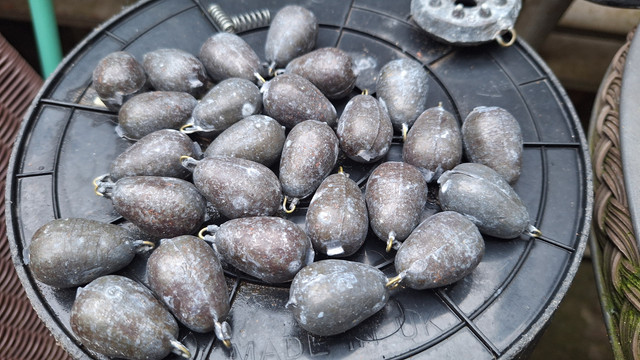
Lead making tips...
Make sure everything is bone dry, pre-heat the moulds to remove and condensation and get up to temperature. Use a ply board as base to work on, a cheapo metal ladle that's shaped to a pouring lip works great to ladle molten lead from the pan.
Never lift the pan with molten lead in it...

Maybe 25% normal vinegar in water, leave for a couple of days (out of the rain) and leads will go light grey.
Then drain and keep the solution for next time, and now leave the leads out doors in rain water for a few more days.
Now leave them outdoors but allow them to dry off and they will soon go a nice dark grey.
Lead making tips...
Make sure everything is bone dry, pre-heat the moulds to remove and condensation and get up to temperature. Use a ply board as base to work on, a cheapo metal ladle that's shaped to a pouring lip works great to ladle molten lead from the pan.
Never lift the pan with molten lead in it...
In reply to Post #25
Lovely, thanks
Lovely, thanks
In reply to Post #24

Stop pretending you want the apron for this type of lead work

Stop pretending you want the apron for this type of lead work
In reply to Post #24
Don't forget signage to warn others of the danger

Don't forget signage to warn others of the danger

I used to make and sell leads a lot of the reason for the coating splitting is the coating not being double applied.
I found the best application is to heat the lead with a blow lamp for a couple of seconds flashing the lamp on all sides once this step has been done spoon the powder over the lead until fully covered if the lead ain't hot enough it will not stick. Flash the lamp over until the powder now shines and is molten spoon the second layer on then repeat. I found the best finish is to hang the coated leads in cold water changing the water after 30 leads. A little trick if you want to take the shine off coated leads put them in the cold water for a couple of seconds once the plastic is hard but still warm wipe the lead in tea towel this will dull the coating off.
Good point below and I was also told this during my time making leads that the hardest ones to find whilst diving was uncoated.
For colouring off leads try old tea bags in a pot of water with the leads in to speed up the process.
Pellet shack was the lead company I used to run
I found the best application is to heat the lead with a blow lamp for a couple of seconds flashing the lamp on all sides once this step has been done spoon the powder over the lead until fully covered if the lead ain't hot enough it will not stick. Flash the lamp over until the powder now shines and is molten spoon the second layer on then repeat. I found the best finish is to hang the coated leads in cold water changing the water after 30 leads. A little trick if you want to take the shine off coated leads put them in the cold water for a couple of seconds once the plastic is hard but still warm wipe the lead in tea towel this will dull the coating off.
Good point below and I was also told this during my time making leads that the hardest ones to find whilst diving was uncoated.
For colouring off leads try old tea bags in a pot of water with the leads in to speed up the process.
Pellet shack was the lead company I used to run
Reading ALL pages