


In reply to Post #119
Exactly why on Earth would you use cheap plastic when you could quite easily use a more expensive longer lasting material such as brass for your gears ? I mean it's nothing to do with profit margins is it 😂
Exactly why on Earth would you use cheap plastic when you could quite easily use a more expensive longer lasting material such as brass for your gears ? I mean it's nothing to do with profit margins is it 😂

With reels, which are a reasonably complex machine with gears, bearings, shafts and bushes, there is always going to be a certain amount of wear. When we buy a car we know that there are a number of consumable items which will need replacing during its lifetime - tyres, brakes, sometimes discs, wiper blades, belts, timing chains, cam belts, water pumps etc etc. You don't refuse to buy a certain car because you think the tyres will need changing at sometime in the future.
Reels are no different. Some of the internal components will probably need replacing over its lifetime if it gets a fair amount of use. Bushes for example are a sacrificial item, designed in a softer material so the more expensive harder part like the main shaft doesn't wear but the softer bush does. The more expensive reel should have the ability for these items to be easily replaced, normally inside a push fit housing. Cheaper reels possibly have these items in a non removable setting so it can't be replaced so the reel feels loose and sloppy until it finally just stops working. Also with roller bearing, needle bearings or ball races it's unlikely the reel manufacturer these days actually make their own as it's far cheaper to buy in from a specialised bearing manufacturer, so the bearing around your oscillating shaft is probably the same as one in a microwave turntable or your hoover. This is where servicing comes into play as these items will be replaced,re-lubricated with new lubricants and the whole reel feels new again. Some companies even offer upgrades to better specialist performance parts - just like a car. Also seeing bits of nylon in your reel innards isn't necessarily cost cutting. It is a proven engineering habit as nylon, PTFE and Teflon are to an extent self lubricating due to the slickness of the material. Abu 55's have nylon internal parts and even the earlier metal bodied 77 have nylon main shaft bushes and these were built in the 70's and still going strong ( I have a set of 3).
You expect a high end reel to have decently machined parts and the consumable parts to be easy to obtain and replace as required. You also expect that reputable company to have a decent R&D department which will iron out any design issues and a decent QC process to weed out any sub standard parts or builds. Of course the downside of this is they will probably have a sales department that will spew out bull***** about the moonlight glinting on the subdued colour of the end cap and a finance department which will work out what each unit costs to produce then stick on the profit margin plus extra carp tax!
Reels are no different. Some of the internal components will probably need replacing over its lifetime if it gets a fair amount of use. Bushes for example are a sacrificial item, designed in a softer material so the more expensive harder part like the main shaft doesn't wear but the softer bush does. The more expensive reel should have the ability for these items to be easily replaced, normally inside a push fit housing. Cheaper reels possibly have these items in a non removable setting so it can't be replaced so the reel feels loose and sloppy until it finally just stops working. Also with roller bearing, needle bearings or ball races it's unlikely the reel manufacturer these days actually make their own as it's far cheaper to buy in from a specialised bearing manufacturer, so the bearing around your oscillating shaft is probably the same as one in a microwave turntable or your hoover. This is where servicing comes into play as these items will be replaced,re-lubricated with new lubricants and the whole reel feels new again. Some companies even offer upgrades to better specialist performance parts - just like a car. Also seeing bits of nylon in your reel innards isn't necessarily cost cutting. It is a proven engineering habit as nylon, PTFE and Teflon are to an extent self lubricating due to the slickness of the material. Abu 55's have nylon internal parts and even the earlier metal bodied 77 have nylon main shaft bushes and these were built in the 70's and still going strong ( I have a set of 3).
You expect a high end reel to have decently machined parts and the consumable parts to be easy to obtain and replace as required. You also expect that reputable company to have a decent R&D department which will iron out any design issues and a decent QC process to weed out any sub standard parts or builds. Of course the downside of this is they will probably have a sales department that will spew out bull***** about the moonlight glinting on the subdued colour of the end cap and a finance department which will work out what each unit costs to produce then stick on the profit margin plus extra carp tax!

In reply to Post #122
Very wise words indeed.
Very wise words indeed.
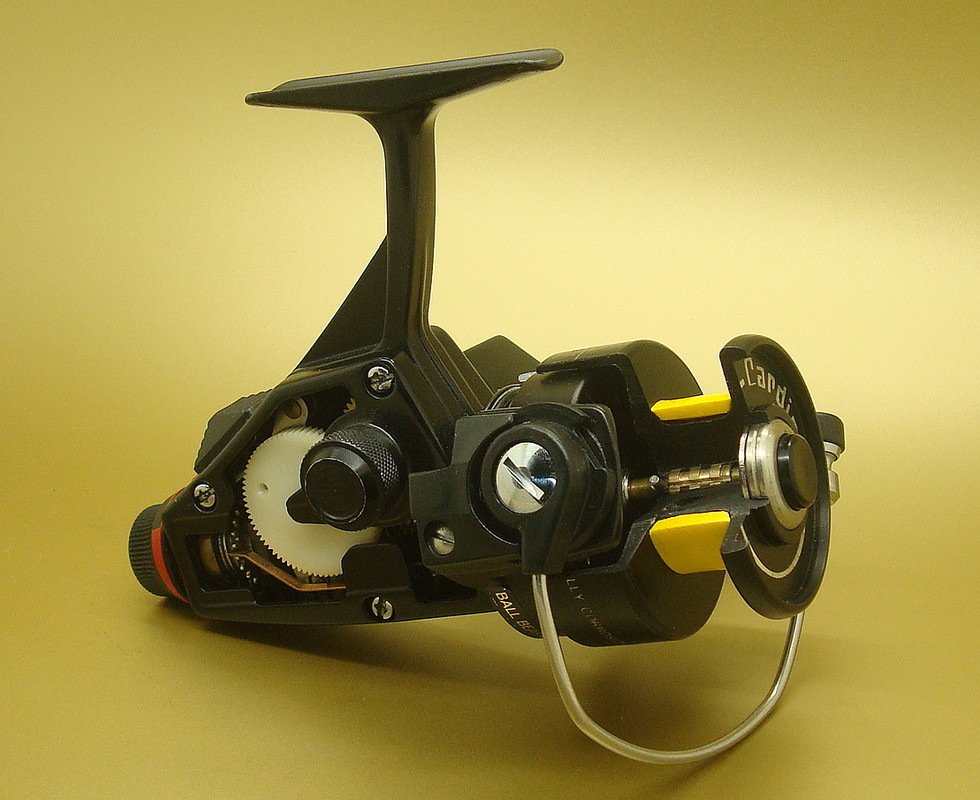
A picture of a 1975 Abu 55 salesman's demo reels showing nylon gear wheel.

In reply to Post #124
I have a pair of Abu 54's in the loft, the gears have gone – not even a good dentist could sort those teeth out
I'm using Mitchell 301's as replacements on my Traditional set up; they have of all things - Ally Gears, but set in a six gear chain to spread the load, and set in a constant semi-fluid grease bath.
I have a pair of Abu 54's in the loft, the gears have gone – not even a good dentist could sort those teeth out
I'm using Mitchell 301's as replacements on my Traditional set up; they have of all things - Ally Gears, but set in a six gear chain to spread the load, and set in a constant semi-fluid grease bath.
In reply to Post #125
Aha...the Mitchell ‘Level Wind Drive System'
Often copied, never bettered......even if it does drive the rotor the wrong way around
Aha...the Mitchell ‘Level Wind Drive System'
Often copied, never bettered......even if it does drive the rotor the wrong way around

In reply to Post #116
What has scrap metal prices got to do with it? Daiwa don't make the gears from scrap and there are loads of different aluminium alloys from cheap to expensive.
Precision cold-forged gears symbolize Shimano's metalworking technology.
Unlike with hot forging, Shimano's precision cold forging technology, in which metal is compressed at room temperatures, achieves excellent precision and strength. The HAGANE Gear is produced by applying about 200 tons of pressure to the raw metal. This technology involves no cutting work to forge a high-precision gear with micron accuracy in a single process, and this is unlike any other in the world. Such quality deserves to be called “transformed metal.
What has scrap metal prices got to do with it? Daiwa don't make the gears from scrap and there are loads of different aluminium alloys from cheap to expensive.
Precision cold-forged gears symbolize Shimano's metalworking technology.
Unlike with hot forging, Shimano's precision cold forging technology, in which metal is compressed at room temperatures, achieves excellent precision and strength. The HAGANE Gear is produced by applying about 200 tons of pressure to the raw metal. This technology involves no cutting work to forge a high-precision gear with micron accuracy in a single process, and this is unlike any other in the world. Such quality deserves to be called “transformed metal.
In reply to Post #114
The only way a reel shaft would bend on a cast is if the big fat angler using it slipped and fell on it. It's a load of old cobblers dreamt up by forum plonkers and their ‘mates'
The only way a reel shaft would bend on a cast is if the big fat angler using it slipped and fell on it. It's a load of old cobblers dreamt up by forum plonkers and their ‘mates'