

Hi, hearing good things about this honey , google shows though there are quite a few types with varying prices as well , any recommends on a worthwhile make ? Thankyou 👍

In reply to Post #1
Hi Chris,
You'll probably have to call them and check this.
I was told years ago that the main sweetener in Haith's nectarblend was Manuka honey, I know it also works well as a basemix as I've used it before.
Best
Jon
Hi Chris,
You'll probably have to call them and check this.
I was told years ago that the main sweetener in Haith's nectarblend was Manuka honey, I know it also works well as a basemix as I've used it before.
Best
Jon

In reply to Post #1
Mark (TCarper) uses that for his GPB1 baits so may be worth asking him........

Mark (TCarper) uses that for his GPB1 baits so may be worth asking him........

Has been mentioned in the last couple of weeks on here in another thread, also see Specialized Hookbaits S2 (heavily honeyed) 👍

Didn't John Baker mention it in a podcast he did?
In reply to Post #5
Was it the korda one ?
Was it the korda one ?

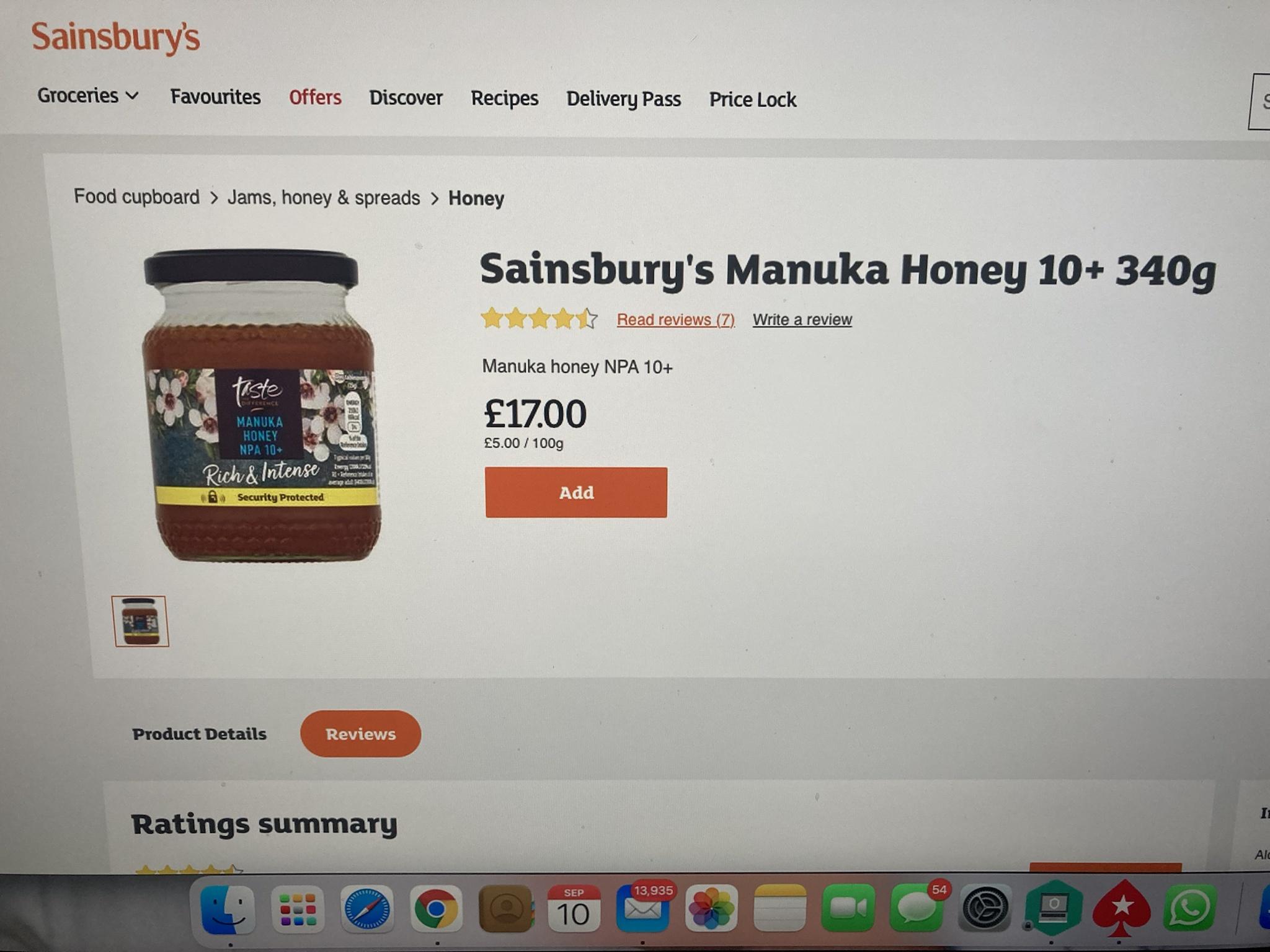
You can spend over £200 on a 700 rated Manuka if you wish. I use this stuff from Sainsbury's. It does the job needed. Dissolve some in your mix with the liquids/eggs when you roll your bait. Then when they are dried after boiling... Mix a tablespoon of this, with enough warm water to dissolve it. Pour it over the finished boiled bait in a bucket. When it's all soaked up dry it again and freeze it.
When you take it out the freezer... Let it sweat in a bag for a day or two until the bait starts to go sticky. It will spore up quite quickly depending on your mix, a white crystallised fungi will develop rapidly on the outside of the bait if you leave it, again depending on your mix and what else is in there.
Natures medicene.
https://www.sainsburys.co.uk/gol-ui/product/sainsburys-manuka-honey-10-340g?
When you take it out the freezer... Let it sweat in a bag for a day or two until the bait starts to go sticky. It will spore up quite quickly depending on your mix, a white crystallised fungi will develop rapidly on the outside of the bait if you leave it, again depending on your mix and what else is in there.
Natures medicene.
https://www.sainsburys.co.uk/gol-ui/product/sainsburys-manuka-honey-10-340g?
In reply to Post #7
Thanks Mark , appreciate that , 👍👍👍👍
Thanks Mark , appreciate that , 👍👍👍👍
In reply to Post #7
Do you think the manuka is better than using fresh honey direct from a local beekeeper?
For what I use it for I find the local stuff better, but decent raw, fresh manuka is expensive so I didn't try it for long
Do you think the manuka is better than using fresh honey direct from a local beekeeper?
For what I use it for I find the local stuff better, but decent raw, fresh manuka is expensive so I didn't try it for long

In reply to Post #6
JB talks about it in the CarpChronicles Podcast @ 2hrs 22mins in
JB talks about it in the CarpChronicles Podcast @ 2hrs 22mins in

In reply to Post #9
Manuka honey contains methylglyoxal which other honey does not have. This has anti-bacterial properties hence it can be good for humans. Does that help carp? I suspect not really but never found a study about it. JB may have said he uses it in a recent pod cast but also admitted that's because he likes the taste not for any other reason!
A good quality local honey will add the same basic sugars.
Buy local and leave the expense stuff from the other side of the world for when it's really needed i.e. to make medical grade honey for wound treatment.
Manuka honey contains methylglyoxal which other honey does not have. This has anti-bacterial properties hence it can be good for humans. Does that help carp? I suspect not really but never found a study about it. JB may have said he uses it in a recent pod cast but also admitted that's because he likes the taste not for any other reason!
A good quality local honey will add the same basic sugars.
Buy local and leave the expense stuff from the other side of the world for when it's really needed i.e. to make medical grade honey for wound treatment.
Just bite your lip Mark, just bite your lip and smile profusely. 
No offence intended to anyone at all. But I have twenty plus years of study about Manuka honey. So what was said on some podcast five minutes ago, or from a quick Google search, is almost offensive to me personally.
For nine years the S2 (Sugars2) has been commercially available for sale. It's actually been in existence for twenty years plus. No one, no one at all knows what is in there and why it's in there... Or what is done to it before it goes in there, or whilst it's in there, except us. That information is actually worth a lot of money funnily enough.
The first time, that anyone actually found out anything we were using whatsoever, was when we released the garlic three years ago, and I put some of the ingredients of the GPB1 on our website. For the previous 6 years, the Sugars2 had caught a few big UK carp... I'm humbled, but not in the slightest bit surprised, that people have been mentioning Manuka honey a little bit since. Bait brains will want to know why lakes get dominated by our hook baits. Why big carp get caught on them again and again and again.
I would undoubtably, if the situation was reversed, and I'm really, really stupid.
Is Manuka honey the be all and end all? No not at all in the slightest. Is it capable of stopping cancer cells from growing, yes it is. Is it capable of killing the bubonic plague? Yes it actually is. It's incredible stuff from mother nature. It was not actually created by mother nature for human beings either
I got asked to do a podcast recently, I also got asked to write a book, twice in the past 12 months. I was very flattered on all occasions.
Anyway, it's better I just shut up now.
No offence intended to anyone at all. But I have twenty plus years of study about Manuka honey. So what was said on some podcast five minutes ago, or from a quick Google search, is almost offensive to me personally.
For nine years the S2 (Sugars2) has been commercially available for sale. It's actually been in existence for twenty years plus. No one, no one at all knows what is in there and why it's in there... Or what is done to it before it goes in there, or whilst it's in there, except us. That information is actually worth a lot of money funnily enough.
The first time, that anyone actually found out anything we were using whatsoever, was when we released the garlic three years ago, and I put some of the ingredients of the GPB1 on our website. For the previous 6 years, the Sugars2 had caught a few big UK carp... I'm humbled, but not in the slightest bit surprised, that people have been mentioning Manuka honey a little bit since. Bait brains will want to know why lakes get dominated by our hook baits. Why big carp get caught on them again and again and again.
I would undoubtably, if the situation was reversed, and I'm really, really stupid.
Is Manuka honey the be all and end all? No not at all in the slightest. Is it capable of stopping cancer cells from growing, yes it is. Is it capable of killing the bubonic plague? Yes it actually is. It's incredible stuff from mother nature. It was not actually created by mother nature for human beings either
I got asked to do a podcast recently, I also got asked to write a book, twice in the past 12 months. I was very flattered on all occasions.
Anyway, it's better I just shut up now.
In reply to Post #11
It's the yeast, enzyme and beneficial bacteria aspect I use it for, so for me it made sense to get it straight from the hive so to speak
It's the yeast, enzyme and beneficial bacteria aspect I use it for, so for me it made sense to get it straight from the hive so to speak
In reply to Post #13
Your spot on there regarding the constituents that have the potential to attract carp and raw honey straight from the hive is best.
Processing of the honey for large scale commercial supply , no matter how slight, always has the potential to reduce the effectiveness of the enzymes, etc.,
The free amino acids range will vary depending on where the bees are collecting pollen from so if you are using it from a specific area you will get consistency of results.
We compared the analysis of over 30 Spanish honeys with the manuka honey , the content was similar in terms of simple sugars, enzymes and free amino acids ( although there was a slight difference in range amongst all the honeys) and some beneficial bacteria strains were also present. As smurf said the big selling point with manuka is the relatively high content of certain antibacterials and its characteristic taste.
Taking into account the high price differential, and some comparative testing we carried out, there is nothing really that I can see that would give any great advantage over raw unpasteurised honey straight from the hive in terms of a fishing bait used for carp,
I realise that others will have a different view ; but at the end of the day it's a personal choice and carrying out some trials as you did would be the way to go.
Your spot on there regarding the constituents that have the potential to attract carp and raw honey straight from the hive is best.
Processing of the honey for large scale commercial supply , no matter how slight, always has the potential to reduce the effectiveness of the enzymes, etc.,
The free amino acids range will vary depending on where the bees are collecting pollen from so if you are using it from a specific area you will get consistency of results.
We compared the analysis of over 30 Spanish honeys with the manuka honey , the content was similar in terms of simple sugars, enzymes and free amino acids ( although there was a slight difference in range amongst all the honeys) and some beneficial bacteria strains were also present. As smurf said the big selling point with manuka is the relatively high content of certain antibacterials and its characteristic taste.
Taking into account the high price differential, and some comparative testing we carried out, there is nothing really that I can see that would give any great advantage over raw unpasteurised honey straight from the hive in terms of a fishing bait used for carp,
I realise that others will have a different view ; but at the end of the day it's a personal choice and carrying out some trials as you did would be the way to go.
In reply to Post #14
There really wasn't much testing involved, the fermented concoction I make with it was for my consumption, but it turned out the carp liked it too. With fresh honey and fresh ingredients the concoction Is ready in a couple of weeks, shop bought raw honey took about 5 - 6weeks the manuka I used took even longer. I didn't like the taste as much with the manuka so most of that went in bait, and I didn't notice any difference when it ran out
There really wasn't much testing involved, the fermented concoction I make with it was for my consumption, but it turned out the carp liked it too. With fresh honey and fresh ingredients the concoction Is ready in a couple of weeks, shop bought raw honey took about 5 - 6weeks the manuka I used took even longer. I didn't like the taste as much with the manuka so most of that went in bait, and I didn't notice any difference when it ran out